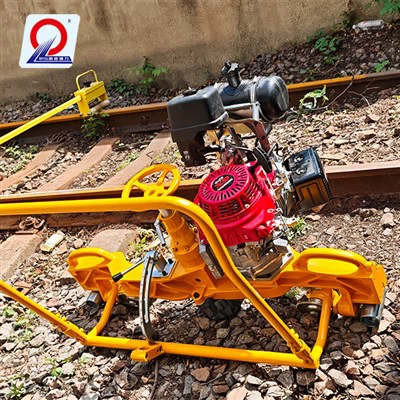
Curved rails are a common feature in railway tracks, and they pose unique challenges when it comes to maintenance. Unlike straight rails, curved rails experience uneven wear and tear due to the forces exerted on them as trains navigate the bends. This uneven wear can lead to a variety of problems, including poor ride quality, increased noise, and even safety issues. That's where rail grinding machines come in. As a leading rail grinding machine supplier, we understand the intricacies of how these machines work on curved rails, and we're here to share that knowledge with you.
Understanding the Challenges of Curved Rails
Before delving into how rail grinding machines operate on curved rails, it's essential to understand the problems that curved rails present. When a train travels around a curve, the outer rail experiences greater lateral forces than the inner rail. This results in accelerated wear on the outer rail's gauge face and running surface, while the inner rail may suffer from less severe wear patterns. Over time, these wear patterns can lead to a phenomenon known as "rail corrugation," which manifests as a series of small, regular ripples on the rail surface. Rail corrugation can cause significant discomfort for passengers, increase the wear and tear on train wheels, and even lead to derailments in extreme cases.
Another issue associated with curved rails is the formation of "gauge widening." As the outer rail wears more quickly, the distance between the two rails (the gauge) can increase. This can cause the train wheels to shift, leading to instability and potential safety hazards. Additionally, the wear on the gauge face of the outer rail can affect the guiding function of the train wheels, making it more difficult for the train to navigate the curve smoothly.
How Rail Grinding Machines Work on Curved Rails
Rail grinding machines are specifically designed to address the unique challenges posed by curved rails. These machines use a combination of abrasive grinding wheels and precise control systems to remove the unevenly worn material from the rail surface, restoring it to its original profile. Here's a step-by-step breakdown of how the process works:


1. Inspection and Planning
Before any grinding takes place, a detailed inspection of the curved rails is conducted. This inspection involves using advanced measurement tools to assess the current rail profile, including the wear on the gauge face, running surface, and the overall gauge width. Based on the inspection results, a grinding plan is developed. This plan specifies the amount of material to be removed from each part of the rail, the grinding pattern to be used, and the sequence of grinding operations.
2. Machine Setup
Once the grinding plan is finalized, the rail grinding machine is set up on the track. The machine is typically a large, self-propelled unit that is equipped with multiple grinding heads. Each grinding head contains one or more abrasive wheels, which are designed to remove material from the rail surface. The grinding heads can be adjusted independently to accommodate the curvature of the rail and the specific grinding requirements.
3. Grinding Process
The rail grinding machine moves along the curved rail at a controlled speed, while the grinding heads are activated. The abrasive wheels rotate at high speeds, removing the unevenly worn material from the rail surface. The machine uses a combination of vertical and lateral movements to ensure that the entire rail profile is treated uniformly. For curved rails, the lateral movement is particularly important to correct the wear on the gauge face and maintain the proper gauge width.
During the grinding process, the machine is constantly monitored to ensure that the grinding is being performed according to the plan. Advanced control systems are used to adjust the pressure, speed, and position of the grinding heads in real-time, based on the feedback from the measurement sensors. This ensures that the correct amount of material is removed from the rail surface, and that the final rail profile matches the desired specifications.
4. Quality Control and Finishing
After the grinding process is complete, a second inspection is conducted to ensure that the rail meets the required quality standards. This inspection involves measuring the rail profile again and checking for any signs of damage or uneven grinding. If necessary, additional grinding operations may be performed to correct any deficiencies.
Once the rail has passed the quality control inspection, a finishing process may be applied to smooth the rail surface and remove any remaining burrs or rough edges. This finishing process can improve the ride quality of the trains and reduce the noise generated during operation.
Our Rail Grinding Machine Solutions
As a trusted rail grinding machine supplier, we offer a range of high-quality machines that are specifically designed for use on curved rails. Our machines are equipped with the latest technology and features to ensure efficient and precise grinding operations. Here are some of our key products:
- Rail Profile Weld Grinder: This machine is designed to grind the welds on rail profiles, ensuring a smooth and even surface. It can be used on both straight and curved rails, and is particularly effective at removing the uneven wear caused by welding.
- Railroad Track Grinding Machine: Our railroad track grinding machine is a versatile and powerful unit that can be used to grind both the running surface and the gauge face of the rails. It is equipped with advanced control systems that allow for precise grinding on curved tracks.
- Train Track Grinder: This compact and efficient train track grinder is ideal for use in areas where space is limited, such as in tunnels or on narrow-gauge tracks. It can be easily maneuvered around curves, and is capable of delivering high-quality grinding results.
Why Choose Our Rail Grinding Machines?
There are several reasons why you should choose our rail grinding machines for your curved rail maintenance needs:
- Advanced Technology: Our machines are equipped with the latest technology and features, including advanced control systems, high-precision grinding heads, and real-time monitoring capabilities. This ensures that our machines can deliver efficient and precise grinding results, even on the most challenging curved rails.
- Customization: We understand that every railway track is unique, and that's why we offer customized solutions to meet your specific requirements. Our team of experts can work with you to develop a grinding plan that is tailored to your track conditions and maintenance goals.
- Reliability and Durability: Our rail grinding machines are built to last. They are constructed from high-quality materials and are rigorously tested to ensure their reliability and durability. This means that you can rely on our machines to perform consistently, even in the most demanding operating conditions.
- Exceptional Support: We provide comprehensive support services to our customers, including installation, training, maintenance, and repairs. Our team of experienced technicians is available 24/7 to assist you with any issues that you may encounter.
Contact Us for Your Rail Grinding Machine Needs
If you're looking for a reliable and efficient rail grinding machine for your curved rail maintenance needs, look no further. As a leading rail grinding machine supplier, we have the expertise and experience to provide you with the best solutions for your railway infrastructure. Whether you need a single machine for a small project or a fleet of machines for a large-scale maintenance program, we can help.
To learn more about our rail grinding machines and to discuss your specific requirements, please contact us today. Our team of experts will be happy to answer your questions and provide you with a customized quotation. Don't let unevenly worn curved rails compromise the safety and performance of your railway system. Invest in our high-quality rail grinding machines and experience the difference they can make.
References
- American Railway Engineering and Maintenance - of - Way Association (AREMA). "Track Inspection Manual."
- European Union Agency for Railways (ERA). "Technical Specifications for Interoperability (TSI) - Track."
- Railway Technical Center. "Research on Rail Grinding Technology for Curved Rails."