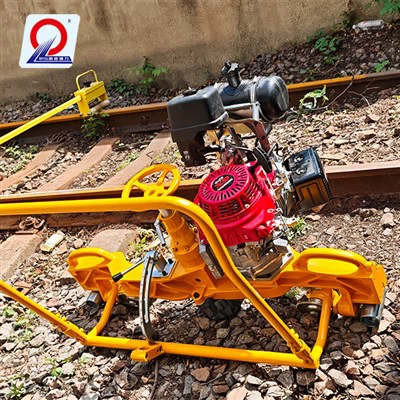
Rail grinding is a crucial process in railway maintenance, especially for newly laid rails. As a supplier of rail grinding machines, I'm often asked about how these machines work on newly laid tracks. In this blog, I'll delve into the intricacies of rail grinding machines and their operation on freshly installed rails.
The Importance of Rail Grinding on Newly Laid Rails
Newly laid rails may have various surface imperfections, such as asperities, unevenness, and residual stress from the manufacturing and laying processes. These imperfections can lead to several problems, including increased wear on the wheels of trains, reduced ride comfort, and even potential safety hazards. Rail grinding helps to eliminate these issues by smoothing the rail surface, improving the contact between the wheels and the rails, and enhancing the overall performance and longevity of the railway track.
Components of a Rail Grinding Machine
A typical rail grinding machine consists of several key components, each playing a vital role in the grinding process.
Grinding Units
The grinding units are the heart of the rail grinding machine. They are equipped with multiple grinding stones or wheels that are designed to remove material from the rail surface. These grinding elements are usually made of high - quality abrasive materials, such as diamond or cubic boron nitride (CBN), which can withstand high temperatures and pressures during the grinding process.
Control System
The control system of a rail grinding machine is responsible for regulating the speed, pressure, and position of the grinding units. It ensures that the grinding process is carried out precisely according to the pre - determined parameters. Advanced control systems use sensors and feedback mechanisms to monitor the grinding process in real - time and make adjustments as needed.
Power System
A powerful power system is required to drive the grinding units and other components of the machine. Rail grinding machines can be powered by diesel engines, electric motors, or a combination of both. The power system must be able to provide sufficient energy to operate the grinding units at high speeds and generate the necessary pressure for effective grinding.
Chassis and Running Gear
The chassis and running gear support the entire structure of the rail grinding machine and allow it to move along the railway track. The running gear is designed to ensure smooth and stable movement, even at high speeds. It also helps to distribute the weight of the machine evenly across the rails, preventing excessive wear on the track.
The Rail Grinding Process on Newly Laid Rails
Inspection and Planning
Before starting the grinding process, a thorough inspection of the newly laid rails is carried out. This includes measuring the rail profile, surface roughness, and the presence of any defects. Based on the inspection results, a grinding plan is developed. The plan specifies the grinding parameters, such as the grinding depth, the number of passes, and the speed of the machine.
Setup and Calibration
Once the grinding plan is finalized, the rail grinding machine is set up and calibrated. The grinding units are adjusted to the correct position and angle relative to the rail surface. The control system is programmed with the grinding parameters, and the power system is checked to ensure proper operation.
Grinding Operation
During the grinding operation, the rail grinding machine moves along the railway track at a controlled speed. The grinding units are brought into contact with the rail surface, and the abrasive wheels start to remove material. The amount of material removed is carefully controlled to achieve the desired rail profile and surface finish.
The grinding process can be divided into two main stages: rough grinding and fine grinding. In the rough grinding stage, a larger amount of material is removed to correct major surface imperfections and achieve the basic rail profile. In the fine grinding stage, a smaller amount of material is removed to refine the surface finish and improve the smoothness of the rail.


Quality Control
Throughout the grinding process, quality control measures are implemented. This includes periodic inspections of the rail surface using non - destructive testing methods, such as ultrasonic testing and magnetic particle testing, to detect any internal defects. The rail profile is also continuously monitored using laser - based measurement systems to ensure that it meets the design specifications.
Advantages of Using Our Rail Grinding Machines
As a leading supplier of rail grinding machines, our products offer several advantages.
High - Precision Grinding
Our machines are equipped with advanced control systems and high - quality grinding elements, which enable high - precision grinding. This ensures that the newly laid rails are ground to the exact specifications, resulting in a smooth and uniform rail surface.
Efficiency
Our rail grinding machines are designed for high - efficiency operation. They can cover a large area of the railway track in a relatively short time, reducing the overall maintenance time and cost.
Customization
We understand that different railway projects may have different requirements. Therefore, our rail grinding machines can be customized to meet the specific needs of our customers. Whether it's a small - scale local railway or a large - scale high - speed rail project, we can provide the right solution.
Reliability
Our machines are built with high - quality components and undergo rigorous testing before leaving the factory. This ensures their reliability and durability, minimizing downtime and maintenance costs.
Where to Find Our Rail Grinding Machines
If you are interested in our rail grinding machines, you can find more information on our website. We have a wide range of products available for sale, including Rail Grinder For Sale, Train Grinder, and Train Track Grinder.
Contact Us for Purchase and Negotiation
If you are considering purchasing a rail grinding machine for your railway project, we encourage you to contact us. Our team of experts is ready to provide you with detailed product information, answer your questions, and assist you in the negotiation process. We are committed to providing the best products and services to our customers, and we look forward to working with you on your next railway maintenance project.
References
- "Railway Track Engineering and Technology" by John B. Kirkland
- "Modern Railway Track" by George Andrew Collingwood
- Industry reports on railway maintenance and rail grinding technology