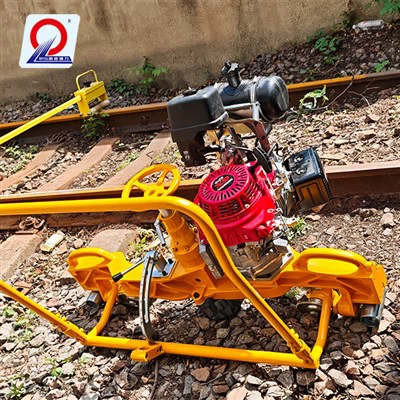
Hey there! As a supplier of rail tampers, I often get asked about the hydraulic systems in these machines. So, I thought I'd write a blog post to explain what they're used for and why they're so important.
First off, let's talk about what a rail tamper is. A rail tamper is a machine used for maintaining railway tracks. Its main job is to pack the ballast (the crushed stones under the tracks) around the railway sleepers (ties). This helps to keep the tracks in the right position, provides a stable foundation for the trains, and reduces wear and tear on the tracks and rolling stock.
Now, let's dive into the hydraulic systems. Hydraulic systems in a rail tamper are like the muscle of the machine. They use fluid pressure to generate and transmit power, allowing the machine to perform various tasks efficiently. Here are some of the key functions of hydraulic systems in a rail tamper:
Tamping Action
One of the primary functions of the hydraulic system in a rail tamper is to drive the tamping tools. The tamping tools are the parts of the machine that actually pack the ballast around the sleepers. The hydraulic cylinders in the system provide the force needed to insert the tamping tools into the ballast and then vibrate them at high speed. This vibration helps to loosen the ballast, allowing it to flow around the sleepers and fill any voids. Once the ballast is properly packed, the hydraulic system retracts the tamping tools.
The hydraulic system also controls the depth and angle of the tamping tools. This is crucial for ensuring that the ballast is packed evenly and at the right density. Different tracks may require different tamping depths and angles depending on factors such as the type of ballast, the weight of the trains, and the track geometry. The hydraulic system allows the operator to adjust these parameters easily, ensuring that the tamping process is tailored to the specific requirements of each track.
Lifting and Lowering the Machine
Another important function of the hydraulic system is to lift and lower the rail tamper. When the machine needs to be moved from one location to another, the hydraulic system raises the tamping unit off the tracks, allowing the machine to be transported on its wheels. Once the machine reaches the new location, the hydraulic system lowers the tamping unit back onto the tracks, ready for the tamping operation to begin.
This lifting and lowering function is also useful during maintenance and inspection. By raising the tamping unit, the operator can access the tamping tools and other components for cleaning, lubrication, and repair. The hydraulic system provides a safe and efficient way to perform these tasks, reducing the downtime of the machine.
Moving the Machine Along the Tracks
The hydraulic system also plays a role in moving the rail tamper along the tracks. In some rail tampers, the hydraulic system drives the wheels of the machine directly. This allows for precise control of the machine's speed and direction. The operator can use the hydraulic controls to move the machine forward or backward at a slow and steady pace, ensuring that the tamping process is carried out smoothly and accurately.
In other rail tampers, the hydraulic system is used to power a conveyor or a winch, which is used to move the machine along the tracks. This type of system is often used in larger, more complex rail tampers that require more power and control.
Adjusting the Alignment of the Tracks
In addition to tamping the ballast, some rail tampers are also equipped with hydraulic systems that can be used to adjust the alignment of the tracks. The hydraulic cylinders in these systems can be used to push or pull the tracks laterally, correcting any misalignments. This helps to ensure that the tracks are straight and parallel, reducing the risk of derailments and improving the ride quality for the trains.
The alignment adjustment function is particularly important on curves and switches, where the tracks are more likely to become misaligned due to the forces exerted by the trains. By using the hydraulic system to make these adjustments, the maintenance crew can keep the tracks in good condition and extend their lifespan.
Advantages of Hydraulic Systems in Rail Tampers
There are several advantages to using hydraulic systems in rail tampers. Firstly, hydraulic systems are very powerful. They can generate a large amount of force, allowing the rail tamper to perform heavy-duty tasks such as tamping the ballast and adjusting the alignment of the tracks. This makes them ideal for use in railway maintenance, where large amounts of force are often required.
Secondly, hydraulic systems are very precise. They allow for accurate control of the tamping tools, the lifting and lowering of the machine, and the movement of the machine along the tracks. This precision ensures that the tamping process is carried out efficiently and effectively, resulting in better track quality and reduced maintenance costs.
Thirdly, hydraulic systems are relatively simple and reliable. They have fewer moving parts compared to other types of power transmission systems, which means there are fewer components that can break down. This reduces the maintenance requirements of the rail tamper and increases its uptime.
Our Rail Tamper Products
At our company, we offer a range of high-quality rail tamper products that are equipped with advanced hydraulic systems. Our Rail Tamper Machine is designed to provide efficient and precise tamping performance. It features a powerful hydraulic system that can drive the tamping tools with high force and accuracy. The machine also has a user-friendly control panel that allows the operator to adjust the tamping parameters easily.
We also offer a Lightweight Railway Track Compactor, which is ideal for smaller-scale railway maintenance projects. This compact and portable machine is equipped with a hydraulic system that provides sufficient force for tamping the ballast around the sleepers. It is easy to operate and can be transported to different locations quickly.


In addition, we have a Railway Maintenance Flat Car that can be used to transport the rail tamper and other maintenance equipment along the tracks. The flat car is also equipped with a hydraulic system that allows for easy loading and unloading of the equipment.
Contact Us for Purchase and Consultation
If you're in the market for a rail tamper or have any questions about our products, we'd love to hear from you. Our team of experts is always ready to provide you with more information, answer your questions, and help you find the right rail tamper for your needs. Whether you're a railway maintenance company, a contractor, or a government agency, we can offer you the best solutions at competitive prices.
So, don't hesitate to get in touch with us. Let's work together to keep your railway tracks in top condition!
References
- "Railway Track Maintenance: Principles and Practice" by David C. Collingwood
- "Hydraulic Systems and Fluid Power: Theory and Applications" by Anthony Esposito