

Why Lithium-Powered Railway Tools Are Replacing Gasoline and Hydraulic Equipment | QL Railway
Why Lithium-Powered Railway Tools Are Replacing Gasoline and Hydraulic Equipment
Published by QL Railway - Advancing Sustainable Rail Maintenance
On this page
Introduction
The railway maintenance sector has undergone significant transformation in recent years. As global infrastructure grows and sustainability becomes a core business value, many railway authorities and contractors are shifting from gasoline and hydraulic-powered maintenance tools to lithium-powered equipment.
This change is not just about following trends - it reflects measurable improvements in performance, environmental impact, and worker safety.
Traditional railway maintenance relied heavily on internal combustion engines and complex hydraulic systems. These tools were reliable but had drawbacks: excessive noise, emissions, heavy weight, and high maintenance demands.
In contrast, lithium-ion battery technology has matured rapidly, enabling lighter, more efficient, and cleaner railway tools suitable for urban and remote rail networks.
1. Environmental Sustainability: Towards a Greener Railway Industry
The shift to lithium-powered railway tools aligns perfectly with global carbon reduction goals. Gasoline-powered tools emit harmful gases such as carbon monoxide, hydrocarbons, and nitrogen oxides.
These not only contribute to air pollution but also pose health risks to operators working in confined areas such as tunnels and depots.
Lithium-powered tools produce zero emissions at the point of use. This allows railway maintenance to continue safely in environmentally sensitive zones and urban environments without causing air quality degradation.
Moreover, these batteries can be recharged using renewable energy sources like solar or wind, making the entire operation more sustainable. You can read more about EV and battery efficiency in rail and transport.
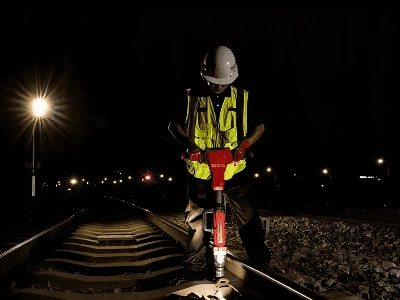
For example, the Railway Sleeper Drilling Machine from QL Railway demonstrates how advanced lithium technology can deliver the same power and precision as fuel-based tools while maintaining environmental integrity. Operators can complete multiple drilling cycles per charge, all without a drop of fuel or emissions.
2. Operational Efficiency: Performance Meets Portability
Hydraulic and gasoline systems traditionally dominated because of their strong torque and endurance. However, lithium technology has now reached a point where it offers comparable - and often superior - performance.
Modern lithium batteries provide consistent voltage output, enabling tools to maintain constant torque throughout operation. This ensures precision in demanding applications such as rail drilling, tamping, and fastening.
Lithium-powered tools are also inherently more mobile. Without the need for external power cables or fuel lines, crews can quickly deploy equipment anywhere along the track. This independence dramatically improves operational efficiency, particularly in remote areas or during emergency maintenance calls.
Take the Railway Impact Gun as an example. Its lithium battery pack offers long-lasting performance, instant startup, and smooth torque control. The result is faster, cleaner, and safer bolt tightening - without the noise and fumes associated with traditional engines. Learn more about ergonomic safety and efficiency.
3. Cost Efficiency and Maintenance Simplification
One of the most practical advantages of lithium-powered railway tools is their low total cost of ownership. Gasoline and hydraulic systems require regular oil changes, filter replacements, fuel handling, and mechanical servicing.
Over time, these tasks add up to significant maintenance costs and downtime. Lithium systems, by contrast, are designed for minimal maintenance.
They have fewer moving parts, no fuel contamination risks, and advanced battery management systems (BMS) that prevent overcharging or overheating. While the initial investment in lithium tools may be slightly higher, the operational savings quickly offset the cost - especially for organizations with large maintenance fleets. For guidance on battery management best practices, see DOE battery safety.
4. Worker Safety and Comfort
Safety remains at the heart of railway maintenance operations. Traditional tools powered by combustion engines generate loud noise, high vibration, and heat. Prolonged exposure can cause operator fatigue and long-term health issues such as hearing damage or vibration-induced strain injuries.
Lithium-powered tools, on the other hand, are quieter, smoother, and lighter. Operators experience less fatigue and can work longer shifts without discomfort. The reduction in noise also benefits nearby communities, making nighttime maintenance operations feasible without disturbing residents.
Additionally, eliminating gasoline fuel removes risks of flammable leaks, toxic fumes, and accidental burns. In confined environments like tunnels or bridges, this represents a significant leap forward in occupational safety. More on safety guidelines: NIOSH Railway Safety.
5. Technological Innovation: Smart Power Management and Connectivity
Lithium-powered railway tools are not just about clean energy-they represent the next generation of smart maintenance technology. Many modern devices integrate digital monitoring systems displaying battery levels, torque data, and operating temperature in real time.
This allows operators to make data-driven decisions, improving work quality and battery utilization. Future advancements include IoT-enabled railway tools capable of syncing with central maintenance platforms, allowing remote diagnostics and predictive maintenance scheduling.
As automation continues to influence railway infrastructure, these smart lithium systems will become essential for data-driven maintenance management. Reference: Railway Gazette Tech.
6. Global Adoption and Industry Outlook
According to a recent Railway Age analysis, global demand for lithium-powered railway maintenance tools is expected to grow by more than 20% annually through 2030.
Countries like Japan, Germany, and China are leading adoption, driven by environmental regulations and infrastructure modernization programs. In Europe, national railway operators are setting emissions reduction targets for all on-site equipment. In North America, contractors are upgrading fleets with battery-powered tampers, drills, and grinders to comply with federal sustainability standards.
The trend is clear: lithium is redefining the standards of railway maintenance. For insights on global transport electrification, see IEA Global EV Outlook 2023.
Performance and Sustainability Comparison
| Parameter | Lithium-Powered Tools | Gasoline/Hydraulic Tools |
|---|---|---|
| Emissions | Zero; eco-friendly and compliant with green policies (EPA standards) | High CO₂ and particulate emissions |
| Operational Noise | Low; ideal for urban and night work | Loud and disruptive |
| Maintenance Frequency | Minimal; electronic monitoring and modular design (DOE battery guidelines) | Frequent servicing required |
| Weight and Portability | Lightweight; easy to transport along track | Heavy and cumbersome |
| Safety | Reduced vibration, low heat, no fumes | High vibration, heat, and fuel hazards |
Conclusion
Lithium-powered railway tools are revolutionizing the rail maintenance industry. With zero emissions, superior ergonomics, reduced maintenance, and smart connectivity, they represent the clear future of efficient, sustainable, and safe railway operations.
For companies investing in the next generation of railway maintenance equipment, embracing lithium technology is no longer optional-it is a strategic move toward efficiency, safety, and environmental responsibility.
Explore our full range of lithium-powered railway tools today.
Contact Us
📧 Email: elinachina@126.com
📞 WhatsApp: +86 15617710309
🌐 Website: www.qlrailwaymachine.com


