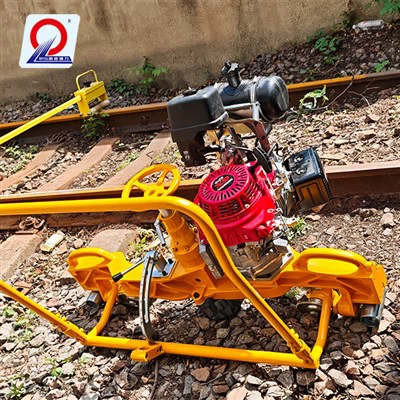
A railway cutter is an essential piece of equipment in railway maintenance and construction. As a reliable Railway Cutter supplier, I understand the importance of knowing its spare parts for ensuring smooth operation and long - term use. In this blog, I will introduce the main spare parts of a railway cutter and their functions.
1. Cutting Blade
The cutting blade is the most crucial part of a railway cutter. It is responsible for actually cutting through the railway tracks. High - quality cutting blades are made from special alloys that can withstand high - temperature and high - pressure conditions during the cutting process.
The material of the cutting blade is usually a combination of tungsten carbide and other hard metals. Tungsten carbide provides excellent hardness and wear resistance, which allows the blade to maintain its sharpness for a long time. The design of the blade's teeth also plays an important role. Different tooth shapes are suitable for different types of railway tracks. For example, a blade with a finer tooth pitch is more suitable for cutting softer rails, while a blade with a coarser tooth pitch can handle harder rails more effectively.


When the cutting blade becomes dull or damaged, it needs to be replaced promptly. A dull blade not only reduces the cutting efficiency but also increases the load on the motor of the railway cutter, which may lead to overheating and premature failure of the motor. You can find high - quality cutting blades for our Railway Cutter in our product range.
2. Motor
The motor is the power source of the railway cutter. It provides the necessary torque and speed to drive the cutting blade. There are mainly two types of motors used in railway cutters: electric motors and diesel motors.
Electric motors are known for their quiet operation, high efficiency, and relatively low maintenance requirements. They are suitable for indoor or noise - sensitive environments. However, they need a stable power supply, which may limit their mobility.
Diesel motors, on the other hand, are more powerful and can work in areas without a power grid. They are often used in outdoor railway construction and maintenance projects. Our Compact Portable Diesel Rail Cutter NQG - 1270Z is equipped with a high - performance diesel motor that can provide sufficient power for cutting various types of railway tracks.
The motor also has some important components such as the stator, rotor, and bearings. The stator generates a magnetic field, and the rotor rotates within this magnetic field to produce mechanical energy. Bearings are used to support the rotating parts of the motor and reduce friction. Regular inspection and lubrication of the bearings are necessary to ensure the smooth operation of the motor.
3. Cooling System
During the cutting process, a large amount of heat is generated due to the friction between the cutting blade and the railway track. If the heat is not dissipated in time, it can damage the cutting blade and the motor. Therefore, a cooling system is an essential part of a railway cutter.
There are two common types of cooling systems: air - cooling and water - cooling. Air - cooling systems use fans to blow air over the hot components to dissipate heat. They are simple in structure and relatively low - cost. However, their cooling efficiency is limited, especially in high - temperature environments.
Water - cooling systems use water as a coolant to absorb and carry away heat. They are more efficient than air - cooling systems but are more complex and require a water source. The water - cooling system usually consists of a water pump, radiator, and water pipes. The water pump circulates the water through the hot components, and the radiator cools the heated water.
4. Transmission System
The transmission system is responsible for transferring the power from the motor to the cutting blade. It usually consists of belts, pulleys, gears, or chains.
Belts and pulleys are a common combination in the transmission system. They are simple, cost - effective, and can provide a certain degree of flexibility. However, belts may slip under heavy loads, which can reduce the transmission efficiency.
Gears and chains are more reliable and can transmit higher torque. They are suitable for high - power railway cutters. Gears provide a precise speed ratio, while chains are more flexible and can adapt to different installation positions.
Regular inspection and adjustment of the transmission system are necessary to ensure proper tension and alignment. Loose belts or chains can cause vibration and noise, and misaligned gears can lead to premature wear.
5. Frame and Housing
The frame and housing of a railway cutter provide structural support and protection for the internal components. They are usually made of high - strength steel or aluminum alloy.
Steel frames are very strong and can withstand heavy impacts and vibrations. They are suitable for heavy - duty railway cutters. Aluminum alloy frames are lighter in weight, which makes the railway cutter more portable. However, they may be less strong than steel frames.
The housing also plays an important role in protecting the internal components from dust, water, and other contaminants. It should be well - sealed to prevent the entry of foreign objects. Some railway cutters are designed with a removable housing, which makes it easier to access and maintain the internal components.
6. Control System
The control system allows the operator to start, stop, and adjust the operation of the railway cutter. It usually includes a control panel, switches, and sensors.
The control panel provides a user - friendly interface for the operator to set the cutting parameters such as speed and depth. Switches are used to turn on and off the power and control the movement of the cutting blade. Sensors are used to monitor the operating status of the railway cutter, such as temperature, speed, and load.
If the sensors detect abnormal conditions, such as overheating or overloading, the control system can automatically shut down the railway cutter to prevent damage. This intelligent control system improves the safety and reliability of the railway cutter.
7. Safety Devices
Safety is of utmost importance in the operation of a railway cutter. There are several safety devices installed on a railway cutter to protect the operator and the equipment.
Emergency stop buttons are one of the most important safety devices. They allow the operator to immediately stop the operation of the railway cutter in case of an emergency. Guards are also installed around the cutting blade to prevent the operator from accidentally coming into contact with the rotating blade.
Some railway cutters are equipped with a safety interlock system. This system ensures that the cutting blade cannot be started unless all the safety conditions are met, such as the proper installation of the blade and the closure of the guards.
Conclusion
As a Railway Cutter supplier, we understand the importance of high - quality spare parts for the performance and longevity of railway cutters. We offer a wide range of spare parts for our Railway Track Cutting Machine and other railway cutters to ensure that our customers can keep their equipment in optimal condition.
If you are interested in our railway cutters or need to purchase spare parts, please feel free to contact us for more information and to start a procurement negotiation. We are committed to providing you with the best products and services.
References
- Railway Engineering Handbook, various editions
- Manufacturer's manuals of railway cutters
- Industry standards and specifications for railway maintenance equipment