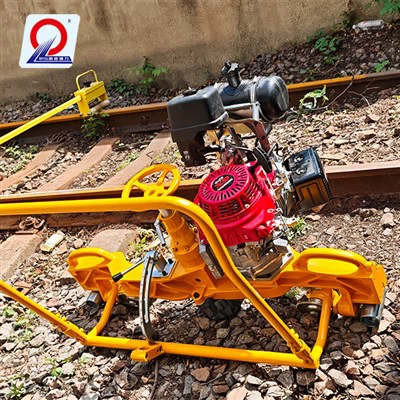
A rail track jack is an essential piece of equipment in the railway maintenance industry. As a reliable supplier of rail track jacks, I am often asked about how these ingenious devices work. In this blog post, I'll delve into the inner workings of a rail track jack, exploring its components, operation principles, and the different types available.
Components of a Rail Track Jack
Before we understand how a rail track jack works, it's crucial to familiarize ourselves with its main components. A typical rail track jack consists of a base, a lifting mechanism, a handle, and a load - bearing surface.
The base provides stability to the jack. It is designed to distribute the weight of the load evenly on the ground, preventing the jack from tipping over during the lifting process. The base is usually made of high - strength steel to withstand the heavy loads associated with railway tracks.
The lifting mechanism is the heart of the rail track jack. There are different types of lifting mechanisms, such as screw - based and hydraulic - based. The screw - type lifting mechanism uses a threaded rod. When the handle is turned, the threaded rod rotates, and due to the interaction between the threads, the load - bearing surface moves up or down. On the other hand, hydraulic lifting mechanisms rely on the principle of Pascal's law. They use a fluid (usually oil) to transfer force from the handle to the load - bearing surface.
The handle is used to operate the lifting mechanism. In screw - type jacks, the handle is attached to the threaded rod, and by turning the handle, the operator can control the movement of the load - bearing surface. In hydraulic jacks, the handle is used to pump the fluid into the hydraulic cylinder, increasing the pressure and causing the piston to move, which in turn lifts the load.
The load - bearing surface is the part of the jack that comes into contact with the railway track. It is designed to provide a secure and stable connection with the track, ensuring that the track can be lifted safely.
How a Screw - Type Rail Track Jack Works
Let's first take a closer look at how a screw - type rail track jack operates. A Railroad Screw Jack is a simple yet effective device.
When you place the screw - type jack under the railway track, make sure the base is firmly on the ground. Then, you start turning the handle in a clockwise direction. As you turn the handle, the threaded rod rotates. The threads on the rod interact with the corresponding threads inside the jack's body. This interaction causes the load - bearing surface to move upwards. With each full turn of the handle, the load - bearing surface moves a fixed distance, which is determined by the pitch of the threads.
The mechanical advantage of a screw - type jack comes from the fact that a relatively small force applied to the handle can generate a large lifting force. This is because the handle provides a long lever arm, and the threads on the rod act as an inclined plane, converting the rotational motion into linear motion.
As you continue to turn the handle, the load - bearing surface gradually lifts the railway track off the ground. You need to be careful and turn the handle at a steady pace to ensure a smooth and controlled lift. When you want to lower the track, you simply turn the handle in the opposite (counter - clockwise) direction, and the load - bearing surface moves downwards.


How a Hydraulic Rail Track Jack Works
Hydraulic rail track jacks are more complex but offer several advantages over screw - type jacks, such as faster lifting speed and the ability to handle heavier loads.
A Metal Railway Jack or a Railway Track Lifting Jack typically follows the principles of hydraulics. The jack has a hydraulic cylinder, a piston, a reservoir of hydraulic fluid, and a pumping mechanism.
When you place the hydraulic jack under the railway track and start operating the handle, you are actually pumping the hydraulic fluid from the reservoir into the hydraulic cylinder. According to Pascal's law, pressure applied to an enclosed fluid is transmitted equally in all directions. When you pump the fluid into the cylinder, the pressure inside the cylinder increases.
The increased pressure acts on the piston inside the cylinder. Since the piston has a larger surface area compared to the area where the force is applied at the handle, a small force applied at the handle can generate a large force on the piston. This large force causes the piston to move upwards, and as the piston moves, it pushes the load - bearing surface, which in turn lifts the railway track.
To lower the track, you usually have a release valve. When you open the release valve, the hydraulic fluid flows back into the reservoir, reducing the pressure inside the cylinder. As the pressure decreases, the piston moves downwards, and the load - bearing surface follows suit, lowering the railway track.
Types of Rail Track Jacks and Their Applications
There are different types of rail track jacks, each designed for specific applications.
- Portable Jacks: These are lightweight and easy to carry. They are ideal for small - scale maintenance work, such as minor adjustments to the track level or for use in areas where access is limited. Portable jacks can be either screw - type or hydraulic - type, depending on the requirements.
- Heavy - Duty Jacks: These are designed to handle large - scale railway maintenance projects. They can lift heavy sections of the track and are often used in major track reconstruction or replacement projects. Heavy - duty jacks usually have a higher lifting capacity and are more robustly built.
- Self - Aligning Jacks: These jacks are designed to automatically align with the railway track. They are useful in situations where the track may be slightly misaligned or uneven. Self - aligning jacks ensure a more stable and secure lift.
Advantages of Using Rail Track Jacks
Using rail track jacks in railway maintenance has several advantages.
Firstly, they improve safety. By using a proper jack, workers can lift the railway track in a controlled and stable manner, reducing the risk of accidents. Jacks are designed to handle the heavy loads associated with railway tracks, ensuring that the track can be lifted without collapsing or causing damage.
Secondly, rail track jacks increase efficiency. They allow workers to quickly and easily lift the track, which speeds up the maintenance process. This is especially important in busy railway networks where downtime needs to be minimized.
Finally, rail track jacks are cost - effective. They are a one - time investment that can be used for multiple maintenance projects. By using jacks, railway companies can save on labor costs and reduce the time required for maintenance.
Conclusion
In conclusion, rail track jacks are indispensable tools in the railway maintenance industry. Whether it's a screw - type Railroad Screw Jack or a hydraulic Metal Railway Jack or Railway Track Lifting Jack, these devices work on well - established mechanical and hydraulic principles to lift railway tracks safely and efficiently.
If you are in the railway maintenance business and are looking for high - quality rail track jacks, we are here to help. Our range of rail track jacks is designed to meet the diverse needs of the industry. We offer reliable, durable, and cost - effective solutions. Contact us today to start a procurement discussion and find the perfect rail track jack for your project.
References
- "Railway Engineering Handbook" by John B. Zarembski
- "Hydraulics and Pneumatics: A Technician's and Engineer's Guide" by Andrew Parr