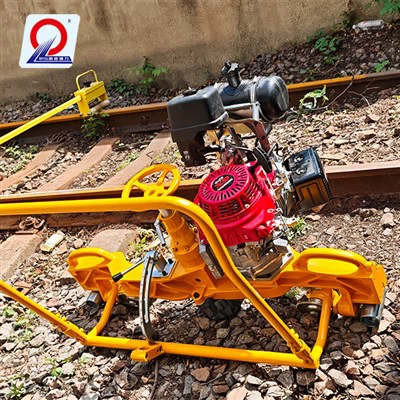
Hey there! As a supplier of rail grinders, I often get asked a really interesting question: "Can a rail grinder be used for monorail tracks?" Well, let's dive right into this topic and find out.
First off, let's understand what a rail grinder is. A rail grinder is a piece of equipment that's used to maintain the surface of railway tracks. It helps to remove irregularities, such as corrugations, shelling, and other forms of wear and tear. By doing so, it improves the safety, comfort, and efficiency of train operations. You can check out more about Rail Profile to get a better idea of the kind of profiles we're dealing with here.
Now, monorail tracks are a bit different from traditional railway tracks. Monorails use a single rail as the support and guidance for the train. They come in two main types: straddle - type and suspended - type. In a straddle - type monorail, the train straddles the rail, while in a suspended - type monorail, the train hangs below the rail.
So, can our trusty rail grinders be used on these monorail tracks? The answer is, it depends.
Compatibility Factors
Track Geometry
The geometry of monorail tracks is quite distinct from that of traditional railway tracks. Traditional tracks usually consist of two parallel rails, and rail grinders are typically designed to work on this configuration. Monorail tracks, on the other hand, have a single rail with a unique cross - sectional shape. For example, some monorail rails have a circular or oval cross - section, which is very different from the flat - topped and tapered - sided profile of a standard railway rail.
If the rail grinder is designed with adjustable grinding heads and a flexible framework, it might be possible to adapt it to the geometry of a monorail track. But this requires careful calibration and customization. You can learn more about different types of grinders like Rail Road Grinder and see if they can be modified for monorail use.
Load and Speed Requirements
Monorail trains often have different load and speed characteristics compared to traditional trains. They might carry fewer passengers or have a different distribution of weight. This means that the wear patterns on monorail tracks can be different. Rail grinders need to be able to handle these specific wear patterns.
For instance, if a monorail operates at a relatively low speed and has a light load, the wear on the track might be less severe and more evenly distributed. In this case, a less powerful rail grinder might be sufficient. However, if the monorail is high - speed and carries heavy loads, a more robust and high - performance grinder like the ones we offer in Train Grinder might be required.
Environmental Conditions
Monorail systems can be installed in a variety of environments, from urban areas to industrial complexes. These environments can expose the tracks to different levels of pollution, moisture, and temperature variations. Rail grinders need to be able to operate effectively in these conditions.
For example, in a coastal area where the monorail is exposed to saltwater and high humidity, the grinder needs to be corrosion - resistant. Our rail grinders are built with high - quality materials that can withstand a wide range of environmental conditions, but additional modifications might be needed for extreme cases.
Advantages of Using a Rail Grinder on Monorail Tracks
Improved Safety
Just like on traditional tracks, grinding the monorail tracks can improve safety. By removing surface irregularities, the risk of derailment is reduced. Smooth tracks also ensure a more stable ride for the monorail trains, which is crucial for passenger safety.
Extended Track Life
Regular grinding can significantly extend the life of monorail tracks. By removing the worn - out layers of the rail, the track can withstand more wear and tear over time. This means less frequent track replacements, which can save a lot of money in the long run.
Enhanced Ride Comfort
Passengers on a monorail will notice a big difference in ride comfort when the tracks are well - maintained. A smooth track surface reduces vibrations and noise, making the journey more pleasant.


Challenges and Limitations
Cost of Adaptation
Adapting a rail grinder for monorail tracks can be expensive. It might involve modifying the grinder's design, purchasing new parts, and conducting extensive testing. This cost needs to be weighed against the benefits of using a rail grinder on monorail tracks.
Technical Expertise
Operating a modified rail grinder on monorail tracks requires specialized technical expertise. The operators need to be trained to handle the unique features of the monorail track and the adapted grinder. This can be a challenge, especially in regions where there is a shortage of skilled workers.
Case Studies
There have been some successful cases where rail grinders have been used on monorail tracks. In a large urban monorail system, the operators were facing issues with track wear and vibration. They decided to try using a modified rail grinder. After some initial adjustments, the grinder was able to effectively remove the surface irregularities on the monorail tracks. As a result, the ride comfort improved, and the number of maintenance - related disruptions decreased.
Conclusion
So, in conclusion, while it is possible to use a rail grinder on monorail tracks, it's not a straightforward process. It requires careful consideration of factors like track geometry, load and speed requirements, and environmental conditions. There are both advantages and challenges associated with using a rail grinder on monorail tracks, but with the right approach and expertise, it can be a viable solution for maintaining monorail track infrastructure.
If you're involved in the maintenance of monorail tracks and are considering using a rail grinder, we'd love to have a chat with you. Our team of experts can help you determine if our rail grinders can be adapted to your specific needs and provide you with a customized solution. Don't hesitate to reach out to us for more information and to start a discussion about your procurement requirements.
References
- Railway Maintenance Handbook
- Monorail System Design and Operation Manual
- Journal of Railway Engineering and Maintenance